Our LARIAT researcher 𝐈𝐯𝐚 𝐏𝐨𝐳𝐧𝐢𝐚𝐤 has published two new papers in 𝐒𝐩𝐫𝐢𝐧𝐠𝐞𝐫 𝐍𝐚𝐭𝐮𝐫𝐞 𝐣𝐨𝐮𝐫𝐧𝐚𝐥𝐬, Discover Sustainability and Discover Applied Sciences, both ranked Q1 according to Journal Citation Reports (JCR). 
Both papers address marine litter from complementary perspectives. One analyses innovative technologies for detecting and removing marine litter, focusing on mitigation approaches, while the other examines human behaviour and structural barriers to reducing single-use plastics, focusing on prevention at the source.
Together, the two studies explore marine litter across the prevention–mitigation spectrum, from factors influencing waste generation to technological approaches for dealing with litter already present in the marine environment.
Both papers are closely connected to SeaClear1 & 2.0 project, but in different ways.
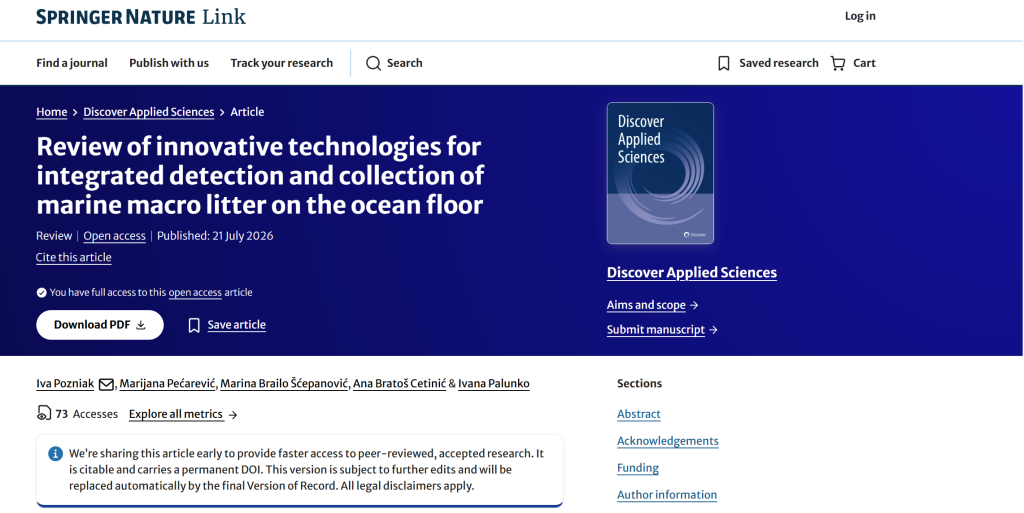
In “𝑅𝑒𝑣𝑖𝑒𝑤 𝑜𝑓 𝑖𝑛𝑛𝑜𝑣𝑎𝑡𝑖𝑣𝑒 𝑡𝑒𝑐ℎ𝑛𝑜𝑙𝑜𝑔𝑖𝑒𝑠 𝑓𝑜𝑟 𝑖𝑛𝑡𝑒𝑔𝑟𝑎𝑡𝑒𝑑 𝑑𝑒𝑡𝑒𝑐𝑡𝑖𝑜𝑛 𝑎𝑛𝑑 𝑐𝑜𝑙𝑙𝑒𝑐𝑡𝑖𝑜𝑛 𝑜𝑓 𝑚𝑎𝑟𝑖𝑛𝑒 𝑚𝑎𝑐𝑟𝑜 𝑙𝑖𝑡𝑡𝑒𝑟 𝑜𝑛 𝑡ℎ𝑒 𝑜𝑐𝑒𝑎𝑛 𝑓𝑙𝑜𝑜𝑟”, the SeaClear and SeaClear 2.0 systems are identified among relevant emerging technologies that integrate the detection, identification and collection of marine litter from the seafloor.
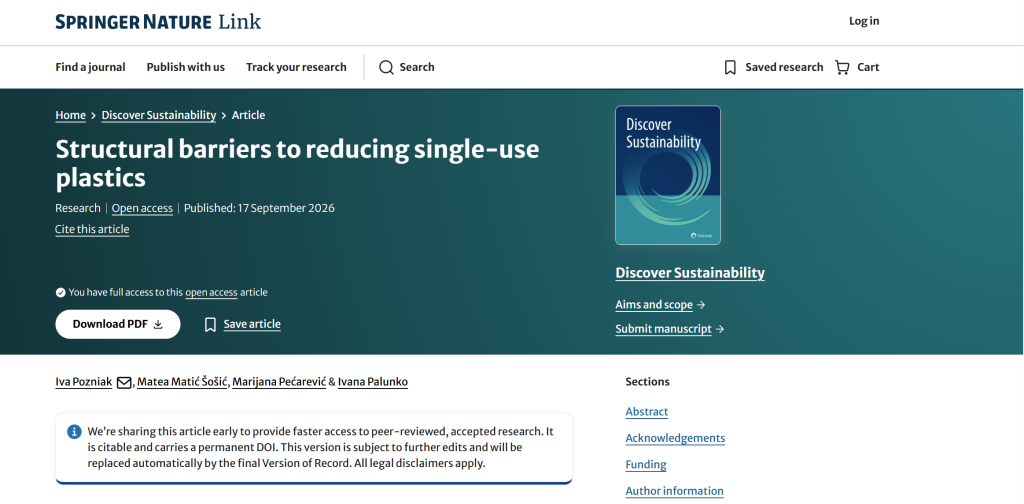
In “𝑆𝑡𝑟𝑢𝑐𝑡𝑢𝑟𝑎𝑙 𝑏𝑎𝑟𝑟𝑖𝑒𝑟𝑠 𝑡𝑜 𝑟𝑒𝑑𝑢𝑐𝑖𝑛𝑔 𝑠𝑖𝑛𝑔𝑙𝑒-𝑢𝑠𝑒 𝑝𝑙𝑎𝑠𝑡𝑖𝑐𝑠”, the SeaClear 2.0 Communities of Practice played an important role in disseminating the survey across Europe. The study included 525 participants from several European countries, providing data on consumer behaviour, attitudes and structural barriers related to reducing single-use plastics and preventing marine litter at the source.
 Discover Applied Sciences
Discover Sustainability
“𝐒𝐭𝐫𝐮𝐜𝐭𝐮𝐫𝐚𝐥 𝐛𝐚𝐫𝐫𝐢𝐞𝐫𝐬 𝐭𝐨 𝐫𝐞𝐝𝐮𝐜𝐢𝐧𝐠 𝐬𝐢𝐧𝐠𝐥𝐞-𝐮𝐬𝐞 𝐩𝐥𝐚𝐬𝐭𝐢𝐜𝐬”
¸+